Chasing Transcendence: The Spirituality of the Sporting Life
I stumbled into it the same two ways Mike Campbell went broke in Hemmingway’s The Sun Also Rises: gradually and then suddenly. Permit me to explain. I have come to understand that in matters of transcendence, language precedes experience. Falling in love, for example, is a relatively new concept in the milieu of human history. People have widely appreciated this innovation and it is now preferred as a catalyst for marriage over its predecessor, the dowry. Without diminishing the power or sincerity of romantic love, I would suggest that the reason we so earnestly seek it out and cling to it with such conviction is that we have been immersed in language that exalts it through literature, art, theater, film, and music. We experience it because we first have the words to describe it.
During my youth I enjoyed fishing and camping and a variety of outdoor activities. I was in my 20’s, however, when I had an experience to which I hope can—or someday will—relate. My friend Flem invited me to join him on an upland hunt at Winghaven Lodge—then an upstart hunt club that has since risen to national acclaim. Everything about it was new to me. The working dogs, the double guns, the culture—all of it was captivating. The defining moment came when his Brittany Spaniel locked on point. Once we were in position, Flem detonated a covey of quail with a lacquered tobacco cane. The eruption from the amber wheatgrass sent me stumbling back in awe, like Saul of Tarsus on the road to Damascus. Then, with new eyes, I watched the birds dissipate into resplendent autumn woods. And I regained my wits to the sound of Flem yelling, “Shoot! Shoot! Got plenty of shells! Just shoot!” Yes, I had, in fact, neglected to shoot. I did not adopt Saul’s three-day abstention from food or drink on account of the spread and the bourbon bar that awaited us at the lodge. Still, I knew in that moment that what I had just experienced would be a defining force in the rest of my life. Being the son of a preacher with my own classical education in theology, I already had the language. It was a conversion, and nothing less.

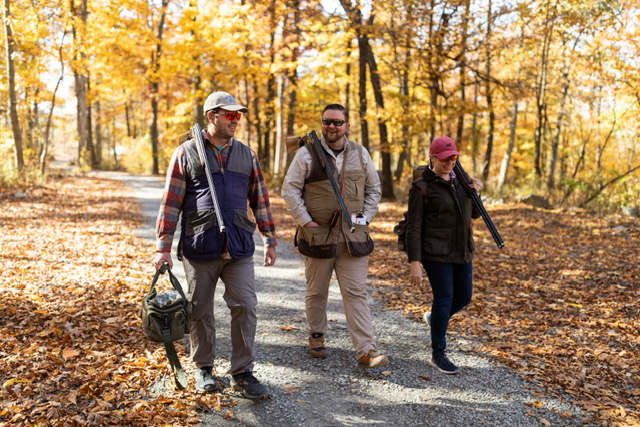
My exploration of the sporting life rooted down to new depths and branched out to new dimensions as time and resources allowed. At first it was entirely subconscious, but those pursuits began to truss themselves up around the spiritual-linguistic framework that was central to my life and to my vocation. You see, I would later find myself serving as a pastor who, fifteen years in, was losing interest in my work and growing weary of the smell of sheep. It happened gradually. A post-hunt bourbon and nosh spread on the tailgate began to feel more like communion than steak rolls and Welch’s juice. Standing in the pull of primordial rivers beneath the vast expanse of the sky did more to spark wonder and contemplation of the greater mysteries than most Sunday services. Friends and acquaintances united by shared passions offered a blessing of community unmatched by my grumbling rabble and their drivelous death march of meetings. And then suddenly, it clicked. I worked every Sunday, so Friday was my sabbath. And in the twilight of my religious profession, I found my sabbath rest on the clays course, in the field, and at the clubhouse of Orvis Hill Country in Fairfield, PA, just off Jacob’s Church Road. How’s that for a sign? There is a literal sign, but I am speaking here of something more elusive and profound. The word for it is epiphany.

Not a New Faith
To be clear, I am not proposing the sporting life as a new faith or religion. Faith is simply the locus of our trust and religious dogma is chiefly about right belief. Hopefully by now you have accrued enough wisdom and humility to know that your beliefs are half flawed, full of holes, and destined to change, unless you decide to stop learning and growing. Yes, we may espouse certain convictions about the relative superiority of flusher versus pointer, over-and-under versus side-by-side, dry fly versus wet, scotch versus bourbon, McGuane versus Harrison, preserve birds versus wild, stocked fish versus natives, and on and on. The advantage of spirituality over religious dogma is that it calls us to rise above all those personal proclivities and above even the more substantial divisions of our time—those rooted in politics, worldview, race, class, and creed. There are people in my life with whom I agree about nothing save for the fact that the smell of a spent shell on cold morning is nearly intoxicating—like an incense reserved for the highest holy days, or that a perfect cast to a rising trout is the earthly epitome of beauty and grace. Spirituality is distinct from faith and dogma in that it is an ecumenical, agnostic, and universal seeking of that which is transcendent. It holds great power to unite, to heal, and to make whole.
Some Practical Examples
I have offered testimony of my conversion and epiphany, of sabbath keeping and worship, of tailgate eucharism and intentional community. This is by no means a comprehensive list. Spirituality is a journey with no end or destination. There is no finishing or mastery, thus no completion or comprehensiveness. There is only growth of deeper roots and wider branches. To give some practical examples and to stir your imagination, you may try this:
- Rather than snapping a picture and shoving the bird in your vest, lift it up with open hands, be still, breathe deep, and offer up a word of thanks (prayer).
- Be quick to invite others to join in your adventures and be generous in your mentorship (evangelism).
- Participate in a local stream cleanup or contribute to a conservation organization (stewardship).
- Wade out into the river and recall the great truth of Heraclitus, that “No man ever steps in the same river twice, for it is not the same river and he is not the same man” (baptism).
- Be modest in what you think you know and forever remain a student (humility).
- Be intellectually curious and take the initiative to learn (study).
- Presume it was your companion’s shot that felled the bird, especially if your companion is a youth or a novice (charity).
- Fish the next hole because you believe it will be fruitful (hope).
- Return as often as you can to the places where you were surprised by joy and your life was indelibly transformed (pilgrimage).

Start there, perhaps, but then make the journey your own and see where it takes you.
A Benediction
In keeping with the spirit of this piece, it seems right to conclude with a few good words, also known as a benediction. And like any proper benediction it will be equal parts expression of hope and call to action. So now, my friends, on this day and on all the days that yet remain, may you know the deep peace and abiding joy that comes from chasing birdy dogs, from the tow of a trout on the bend of your rod, from the clink of glasses and taste of whiskey mingled with the aroma of cigars, and from the enjoyment of the ones you love whose souls are attuned to the sacredness of it all. May this way of being lead you to greater depths of gratitude and to new heights of awe and wonder. And may this sojourn we make together so enrich your life that you are inspired to share it freely with others, graciously, generously, and in ever widening circles. I offer these words because I have come to understand that in matters of transcendence, language precedes experience. And because embracing a spirituality of the sporting life is a lot like falling in love, gradually and then suddenly, making life rich and vivid and swollen with light.
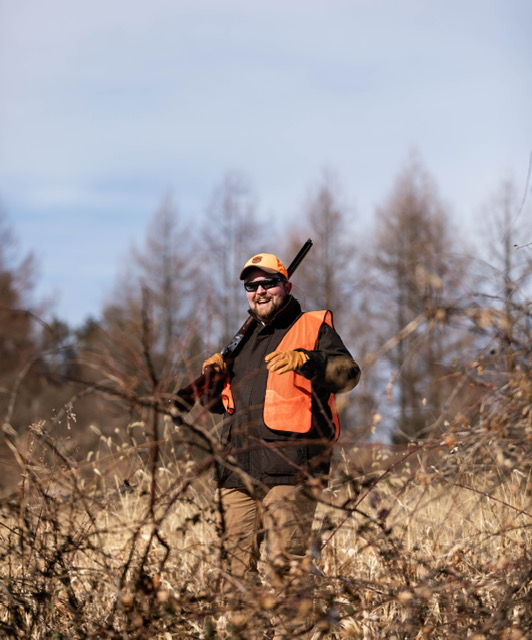
Jake Caldwell pursues the sporting life from western MD where he lives with his wife, daughters, and English Springer Spaniel. As a private wealth manager with Founders Financial Wealth Partners he helps great people live their best financial lives. He can be reached at jakecald@gmail.com.