
From Hamlet to the World
By Michael Maynor
Today is John Coltrane’s 100th birthday.
The first time I remember hearing his name was not through a jazz record. It was in Brad Paisley’s “Old Alabama.” The song brushes past the words “Forget about Sinatra or Coltrane,” and at the time I knew enough to recognize Sinatra, but not the other name. Coltrane stayed filed away somewhere in my mind.
I have always enjoyed jazz, though I have never claimed to understand it as a scholar would. For me, it is often atmosphere first: an autumn evening, the lights low, a candle lit, and an “Autumn Jazz” mix easing the house out of the day.
Then I came across a story online about efforts to preserve one of Coltrane’s North Carolina homes. That led me to a fact I could hardly believe I had missed: John Coltrane was born in Hamlet.
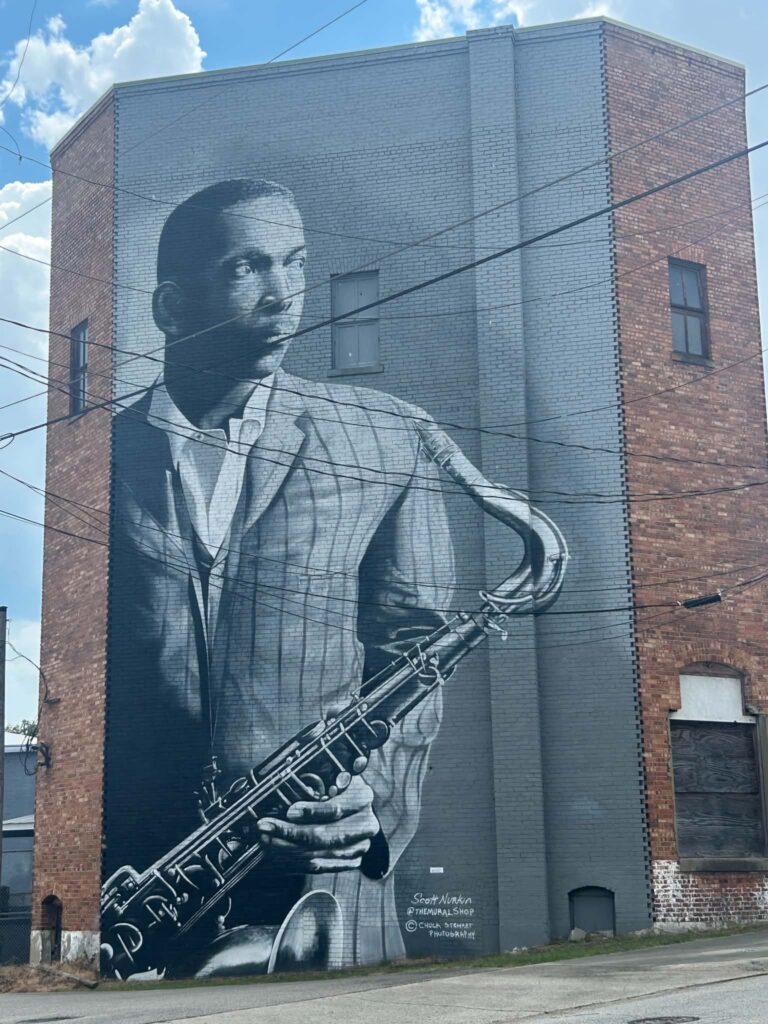
Last September, on the way to a friend’s wedding in Monroe, Robbie and I turned the car toward Hamlet. I had passed through Hamlet and neighboring Rockingham countless times growing up, even after artist Scott Nurkin painted Coltrane’s towering portrait on the side of an old downtown building. Yet I had only recently learned the mural was there.
Standing beneath it felt like discovering a door in a familiar room.
I am not coming to Coltrane as an expert. I am coming as a North Carolinian who knows enough to be amazed – and who wants to listen more closely. On his 100th birthday, that may be as honest a place as any to begin.
The North Carolina Beginning
John William Coltrane was born on September 23, 1926, on Bridges Street in Hamlet, a small railroad town in Richmond County. When he was three months old, his family moved to High Point, where he would spend the remainder of his childhood.
Coltrane grew up in a religious household. His father preached, his grandfather was a minister, and the sound and spiritual language of the church entered his life early. At William Penn High School, he played clarinet before taking up the saxophone.
In 1938, when Coltrane was barely twelve, his father and grandfather died, followed within months by his grandmother and an aunt. The losses devastated the family emotionally and financially. Music became an increasingly important part of the young Coltrane’s life – a source of direction during a period of grief and upheaval.
After graduating from high school in 1943, he moved to Philadelphia and immersed himself in the city’s thriving music scene. In August 1945, he enlisted in the United States Navy. Stationed at Manana Barracks on Oahu, Hawaii, he played clarinet and alto saxophone with a Navy band called the Melody Masters. An informal session with fellow servicemen in July 1946 produced his first known recordings.
Following his discharge in August 1946, Coltrane returned to Philadelphia. He used the G.I. Bill to study music and spent the following years learning his profession wherever he could find work. He performed with groups led by Dizzy Gillespie, Earl Bostic, and Johnny Hodges, gradually making the tenor saxophone his principal voice.
Lorem ipsum dolor sit amet, consectetur adipiscing elit. Ut elit tellus, luctus nec ullamcorper mattis, pulvinar dapibus leo.
Lorem ipsum dolor sit amet, consectetur adipiscing elit. Ut elit tellus, luctus nec ullamcorper mattis, pulvinar dapibus leo.
The Long Ascent
Coltrane’s breakthrough came in 1955, when Miles Davis hired him. His work with Davis carried him from relative obscurity to national recognition while placing him inside one of the most important groups in modern jazz.
The ascent was not uninterrupted. Coltrane developed a heroin addiction during his years as a traveling musician, and Davis dismissed him in 1957 after the addiction began interfering with his appearance and performance. Coltrane broke the habit that year and returned to music with renewed discipline and purpose.
The change was remarkable.
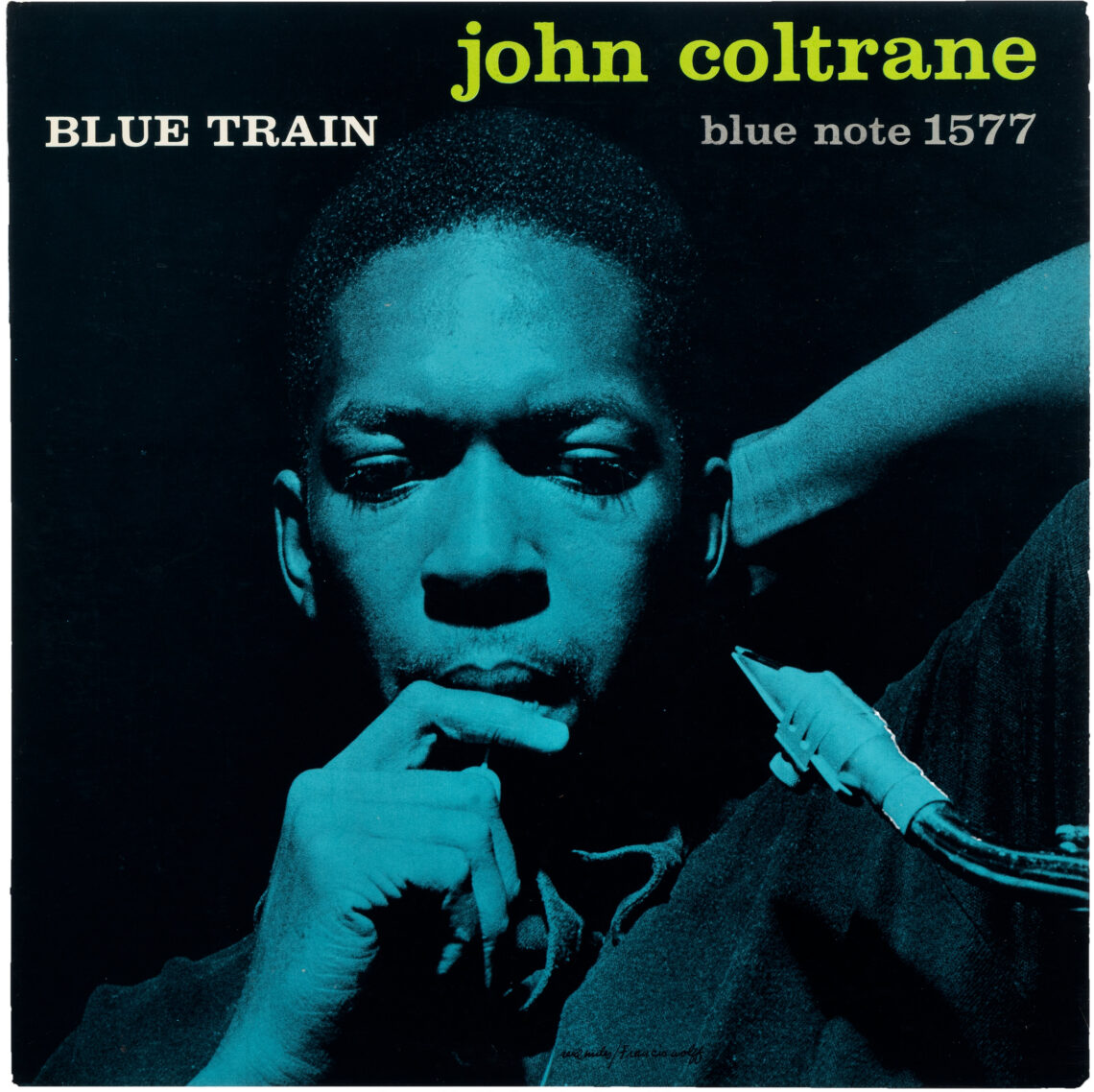
In 1957, he recorded his first album as a leader, Coltrane, for Prestige Records. He spent part of that year performing with pianist Thelonious Monk, whose unusual harmonies and fearless musical logic left a lasting impression on him. That September, Coltrane recorded Blue Train – his second album as a leader and his sole recording under his own name for Blue Note Records. It was one of the first records to reveal the full strength of his voice as both a performer and composer.
Coltrane later returned to Davis and appeared on Kind of Blue, recorded in 1959 and now regarded as one of the defining albums in jazz. That same year, Coltrane recorded Giant Steps. Released in 1960, the album pushed harmony and improvisation into demanding new territory and announced that Coltrane was becoming much more than a celebrated sideman.
He left Davis in the spring of 1960 and formed his own group. His transformation of the familiar show tune “My Favorite Things” became his signature recording and greatest commercial success. Playing soprano saxophone, he turned the melody into something hypnotic, spacious, and unmistakably his own.
By 1962, the group remembered as Coltrane’s Classic Quartet was in place: McCoy Tyner on piano, Jimmy Garrison on bass, Elvin Jones on drums, and Coltrane on saxophone. Together, they created the foundation for his most celebrated work.
A Sound Still Searching
What makes Coltrane’s music remarkable is not simply how much he accomplished, but how quickly he continued to change.
He could be tender and restrained. His 1962 recording of “In a Sentimental Mood” with Duke Ellington remains one of the most graceful performances of his career. Coltrane does not overwhelm the melody. He gives it room to breathe.
He could also make music carry the weight of the world around him. On November 18, 1963, the quartet recorded “Alabama,” widely understood as Coltrane’s response to the bombing of Birmingham’s Sixteenth Street Baptist Church, where four Black girls had been killed two months earlier. The piece is mournful without becoming theatrical – an elegy spoken through restraint, repetition, and sound.
In December 1964, Coltrane recorded A Love Supreme, a four-part suite expressing gratitude, devotion, and spiritual renewal. Released in early 1965, it became his best-known album and one of the defining works of twentieth-century music.
Even then, Coltrane did not settle. His later work moved toward freer, denser, and more challenging forms. He continued to practice, perform, and record during the final months of his life. Coltrane died of liver cancer on July 17, 1967. He was forty years old.
The music kept traveling.
At the 1982 Grammy Awards, Coltrane received a posthumous award for “Bye Bye Blackbird” in the category of Best Jazz Instrumental Performance, Soloist. The Recording Academy honored him with its Lifetime Achievement Award in 1992. In 2007, the Pulitzer Prize Board awarded him a special citation recognizing his masterful improvisation, musicianship, and central place in the history of jazz.
Giant Steps was selected for preservation in the National Recording Registry in 2004, followed by A Love Supreme in 2015.
Those honors establish his place in history. The recordings explain why the music remains alive.
Where I Am Beginning
A catalogue as large and adventurous as Coltrane’s can be intimidating. These six recordings are not intended as a definitive ranking. They are simply six open doors – and the places where my own listening is beginning.
1 In a Sentimental Mood
Recorded with Duke Ellington, this is the performance that first reached me personally. It is elegant, warm, and unhurried. Coltrane’s playing demonstrates that restraint can be every bit as powerful as intensity.
2 Blue Train
Recorded in September 1957 for Blue Note, “Blue Train” offers an accessible entrance into Coltrane as a leader and composer. It is grounded in the blues, driven by a memorable theme, and filled with the forward momentum that would come to define his music.
3 Giant Steps
This is Coltrane at his most technically and harmonically demanding. The composition moves through rapidly shifting chords that continue to challenge musicians. Even without understanding the theory behind it, a listener can hear the urgency and concentration.
4 My Favorite Things
Coltrane takes a familiar Broadway melody and opens it into an entirely different musical landscape. His soprano saxophone circles the theme while the rhythm creates an almost hypnotic sense of motion. It became his signature recording for good reason.
5 Alabama
Quiet, mournful, and deeply controlled, “Alabama” shows how Coltrane could address grief without words. Knowing the history behind the piece makes its measured intensity even more affecting.
6 A Love Supreme
This is best heard as a complete work rather than as a collection of separate songs. Its four movements – “Acknowledgement,” “Resolution,” “Pursuance,” and “Psalm” – form a spiritual arc. It is both a personal testimony and an invitation to listen beyond the surface.
The Road Back to Hamlet
A century after Coltrane’s birth, his North Carolina connections remain visible. The Bridges Street building where he was born still stands in Hamlet, and his childhood home remains on Underhill Street in High Point. In downtown Hamlet, Nurkin’s mural turns an otherwise familiar wall into a towering tribute.
The boy born in a North Carolina railroad town went on to create music that crossed geographical, cultural, and spiritual boundaries. His life was brief, but his artistic journey never stood still. He kept reaching for another sound, another form, and a clearer means of expression.
I am still at the beginning of my own listening. Perhaps that is the most fitting way for me to mark John Coltrane’s centennial – not by pretending to have every answer, but by putting on a record, lowering the lights, and beginning to listen.
An illustrated version of this story will appear in the Fall 2026 edition of Feathers & Whiskey Journal.

Michael Maynor
I am a proud native of North Carolina with a deep love for the sporting lifestyle and everything Southern. My book collection seems to grow endlessly, and I have a particular fondness for collecting vintage duck decoys. Despite appearing content, my heart longs to return to Africa for another safari adventure. John 3:16

You May Also Like

Southern Desserts: The Real Holiday Playoff
December 18, 2023
“I’ll Have A Double!” – South Carolina Lowcountry
May 31, 2022