What Your Knife Says About You
Your hunting knife is the closest thing to a signature you carry in the field. It says whether you’re a tool guy, a weight-weanie, or someone’s granddad who’s been carrying the same Case since before you were born. A carbon steel blade with a patina tells a different story than a $400 custom in a Kydex sheath, and neither one is wrong if it actually gets used. The real tell isn’t the knife itself — it’s whether the edge is sharp when you pull it out.
I’ve hunted with guys who carry a Havalon replaceable-blade and treat it like a medical instrument. They’ll field dress a deer with the precision of a surgeon, swap the blade, and put it away clean. I’ve hunted with guys who carry a fixed-blade Buck they found at a pawn shop for twelve dollars. Their knife is dull, covered in sap from last season, and they forgot to bring a sharpener. You can guess which one I trust more in a pinch.
But the knife tells a deeper story than preparedness. It tells origin.
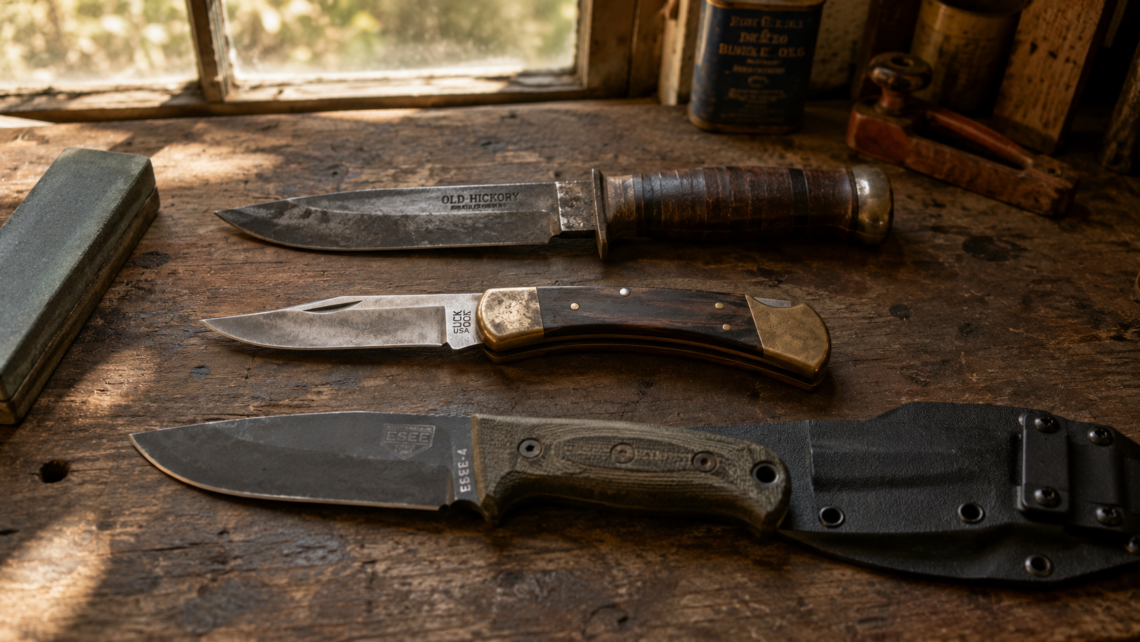
A man carrying a carbon steel Old Hickory with a stacked leather handle probably learned from someone who learned from someone. That knife has history. The blade has a patina — a dark, gray-blue stain that comes from years of use, from blood and apple juice and whatever else got wiped off on a pant leg. That patina isn’t dirt. It’s armor. It means the knife has been used enough to develop its own protection against rust. A knife like that has stories, even if the owner doesn’t tell them.
Meanwhile, there’s the custom knife guy. Damascus blade, stabilized wood handle, a sheath that cost more than most people’s hunting boots. There’s nothing wrong with that knife. But you watch how he handles it. Does he use it, or does he show it? If he’s afraid to scratch the blade, that knife says something different than he thinks it does.
And then there’s the old Buck 110. The folding hunter. A design that hasn’t changed in sixty years because it doesn’t need to. Brass bolsters, wood scales, a blade that locks open with a solid click. Millions of them have been carried. Millions of deer have been processed with them. If you see a Buck 110 with the brass worn smooth and the blade sharpened down to a sliver of its original profile, you’re looking at a knife that has done its job for decades. That knife could tell you more about American hunting than any magazine article ever could.
The secret that cuts through all of this: nobody cares what knife you carry as long as it’s sharp. A $20 Mora with a fresh edge will outperform a $500 custom that hasn’t seen a stone in two years. Sharp is the only status symbol that matters in the field.
So carry what you want. Carry your grandfather’s knife. Carry a replaceable-blade. Carry a fancy custom. Just make sure it’s sharp when you need it. Because that’s what your knife actually says about you: whether you respect the work enough to show up ready.

Robbie Perdue
is a native North Carolinian who enjoys cooking, butchery, and is passionate about all things BBQ. He straddles two worlds as an IT professional and a farmer who loves heritage livestock and heirloom vegetables. His perfect day would be hunting deer, dove, or ducks then babysitting his smoker while watching the sunset over the blackwater of Lake Waccamaw.