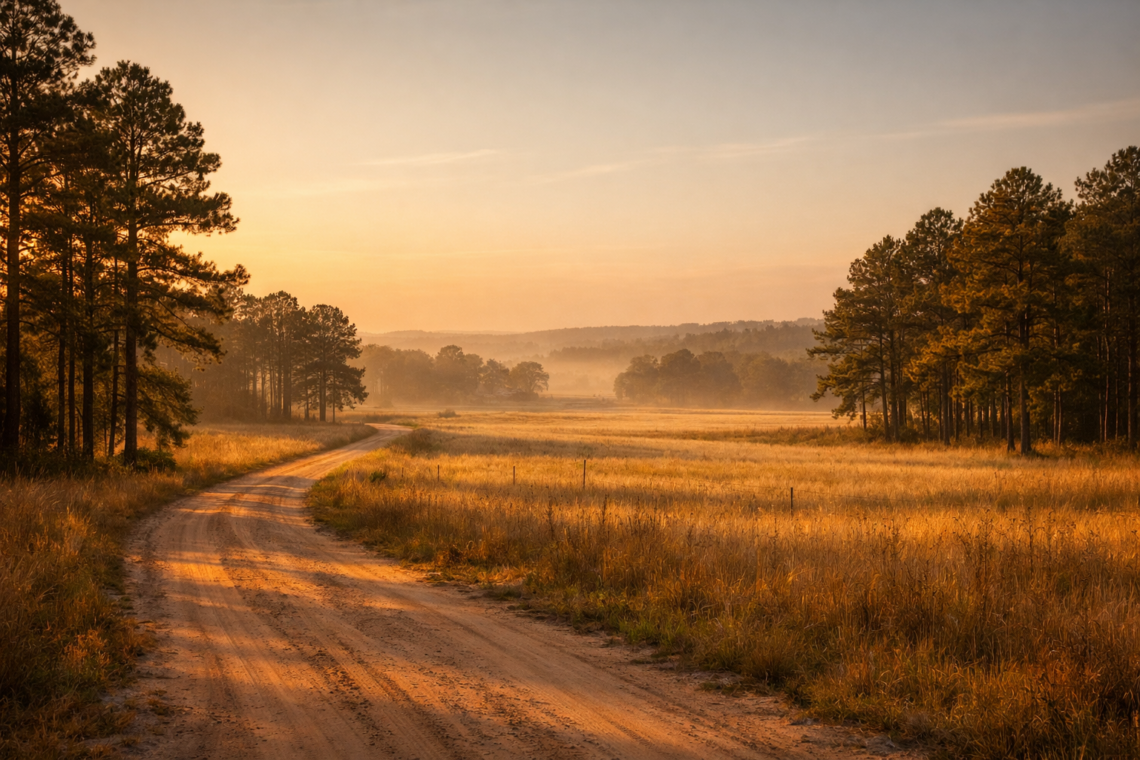
Before there were houses, there were fields.
Before there were families, there was land.
And before anyone had a story worth telling, there was a place that made it possible.
That’s the part most people miss.
In the South, stories don’t start with people. They start with where those people stand.
A piece of land holds more than dirt. It holds memory. It holds work. It holds the quiet accumulation of everything that’s happened there—good, bad, and forgotten. Long before someone tells a story about a hunt, a storm, or a Sunday afternoon, the land has already decided how that story will feel.
Flat land tells a different story than rolling hills. Pine country speaks differently than river bottoms. Sand feels different under your boots than clay, and if you’ve spent enough time in both, you don’t need anyone to explain why.
Land shapes rhythm.
It decides when you wake up, what you plant, how you move, and what you pay attention to. It teaches patience in places where nothing happens fast, and urgency in places where everything can change overnight. It teaches you to read things most people never notice—wind direction, water lines, the way light falls across a field just before dark.
And over time, it shapes the people who live on it.
That’s why Southern stories carry weight even when they’re simple. They aren’t just about what happened. They’re about where it happened. And that “where” is doing more work than most people realize.
A man doesn’t just tell you about a deer he killed. He tells you about the edge of a field, the stand of hardwoods behind him, the way the frost sat that morning. Because without those details, the story doesn’t mean anything.
Take the land out of it, and you’re left with nothing but events.
Put the land back in, and it becomes something worth remembering.
The truth is, the South never really separated people from place. Even now, when things move faster and farther than they used to, the connection is still there. You can hear it in the way people give directions. You can see it in the way property is talked about—not as an asset, but as something that’s been held, worked, and passed down.
Land isn’t background here.
It’s the foundation.
And if you want to understand any story that comes out of the South, you don’t start with the people.
You start with the ground beneath their feet.